
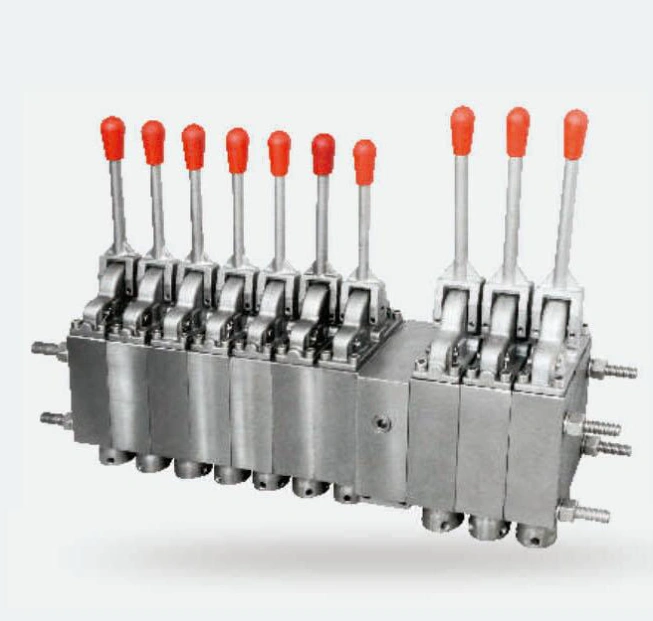
1. Start with the parent assembly, not the loose component
Record the equipment reference and the full valve-bank identification from existing approved records. Then state exactly what needs to be supplied. A request for a complete bank is different from a request for one component installed within it, even if the same equipment description appears on both inquiry lines.
Use a drawing or parts-list reference to show the boundary. If the required item cannot yet be identified, label the request as an identification inquiry rather than a confirmed replacement order. A supplier should be able to distinguish the original assembly from the item being purchased without interpreting an informal photograph caption.
2. Preserve the entire catalogue designation
The supplied catalogue includes separate records for FHS320/31.5(5+1) and FHS320/31.5(7+1), alongside FHS400/31.5(3). Keep the full designation, including parentheses, in the inquiry. Shortening both FHS320 references to “FHS320 valve” removes information needed to distinguish the catalogue entries.
These records also carry paired-listing notes. The catalogue panel does not establish a separately confirmed rating for every named model, and FHS400/31.5(3) appears in more than one paired heading. Do not infer a circuit function, approved number of operations or performance rating from the model text alone. Ask for the exact offered assembly drawing and data sheet.
Reference: FHS320/31.5(5+1) — catalogue assembly record · FHS320/31.5(7+1) — separate catalogue assembly record · FHS400/31.5(3) — paired-listing and confirmation notes
3. Write one line for each supply boundary
A comparison becomes clearer when the supplier answers a specific scope statement. Use the same fields for each quotation and mark absent information as “not confirmed.” The examples below are inquiry formats, not claims that every catalogue bank is available in each form.
Do not create an assumed section, spool or cartridge designation from the exterior photograph. If a replaceable subassembly is proposed, request its own identification and the evidence connecting it to the original bank. The supplier must clarify the deliverable rather than leave the buyer to infer it from a general product name.
| Requested scope | What the offer should identify | Common unresolved question |
|---|---|---|
| Complete valve-bank assembly | Exact offered assembly reference, drawing revision and included components | Which parts shown in the photograph are actually included? |
| Individual component for an existing bank | Component reference and confirmed parent-assembly compatibility | Does the response identify the installed assembly as well as the loose part? |
| Seals, fittings or accessories | Itemized references and quantities, with compatibility evidence | Are these included, optional or excluded? |
| Alternative configuration | Proposed differences from the original requirement | Who must approve the differences before ordering? |
4. Confirm the control and connection arrangement
Give the supplier the existing hydraulic schematic and installation drawing where available. Ask it to identify the proposed arrangement on the corresponding documents: controlled functions, port identification, connection details, mounting and orientation. Review those documents through the responsible equipment specialist, not through a visual similarity check alone.
A catalogue illustration may show several handles or connections without establishing how a particular installed assembly is configured. Keep labels tied to the drawing revision. If a port, handle or component is not identified, record it as an open question rather than assigning a guessed function. This guide does not authorize rerouting lines or changing the equipment’s controls.
5. Separate included parts from retained equipment
Add an explicit inclusion-and-exclusion list to the inquiry. It should make clear which items arrive with the proposed assembly and which remain part of the customer’s existing equipment.
Keep “included,” “excluded” and “awaiting confirmation” distinct. A blank quotation field should not become an implicit inclusion. If the supplier revises the scope, keep the new item list with the revised price so that the purchasing team is comparing the same deliverable.
- Main assembly: exact model, configuration and applicable drawing.
- Operating parts: identify the controls or actuation items included in the offer.
- Interfaces: itemize supplied connectors, seals and mounting parts, if any.
- Documentation: list the required assembly drawing, parts list, data sheet and applicable model-specific records.
- Exclusions: identify any items shown in reference images that are not part of the delivery.
6. Review technical exceptions before commercial comparison
Ask for a separate list of deviations from the inquiry. These may concern the configuration, interfaces, supplied material, fluid suitability or documentation. Copy the actual equipment requirements into the inquiry and request confirmation for the offered model; do not use an unexplained value in a model code as the approved system requirement.
When the source catalogue itself is ambiguous, keep that issue visible. The CHILL records flag printed flow-unit and material-description questions rather than silently resolving them. A proposal that leaves these matters unanswered is not technically equivalent merely because its price and delivery date are attractive.
Reference: Catalogue discrepancies — how to request written clarification
7. Make the final comparison revision-specific
Use a short comparison sheet with one row per supplier offer and separate columns for model, scope, drawing revision, inclusions, exclusions, exceptions, quantity and commercial terms. Mark which offers have completed technical review before presenting a price comparison as like-for-like.
Retain the approved drawing and itemized scope with the order. If the supplier changes the bank or a component reference after approval, return the affected change for review instead of treating it as an administrative substitution. Installation, testing and maintenance remain subject to the equipment manufacturer’s instructions and the site’s authorized procedures.
Frequently asked questions
Can I omit (5+1) or (7+1) from an FHS320 inquiry?
Keep the complete printed designation. The catalogue lists separate records with those suffixes, and the exact offered configuration still needs confirmation against its drawing and data sheet.
Does a valve-bank photograph show everything included in the price?
Not necessarily. Ask for an itemized scope showing what is included, excluded or awaiting confirmation; do not treat a reference photograph as the contractual delivery list.
Can a component quotation be compared directly with a complete-bank quotation?
Only after the supply boundaries are made equivalent or the differences are explicitly accounted for. Identify the parent assembly, exact supplied items and required technical approvals before comparing prices.
Turn the checklist into a clear inquiry.
Use your model, drawing revision and application requirements to start the next discussion.
Browse all hydraulic component records Prepare a complete component RFQ Review model-specific document limitations Explore hydraulic products Prepare a technical inquiryGeneral purchasing information, not equipment-specific engineering approval. Installation, pressure settings, substitutions and maintenance require the responsible specialist and the equipment manufacturer’s procedures.